
(Or: How to Stop Torturing Yourself)
The Upstream Problem
Here’s why your life sucks:
You think you’re the story. The one who has problems, needs solutions, wants things to work out. The one who’s stuck, trying to get unstuck, failing, trying harder.
That’s not actually you. That’s identity. The ego. The personality structure that formed when you were a kid because you needed to survive, and surviving meant being someone recognizable, someone who fit in, someone who could navigate the world.
And it worked. You survived.
But now you’re stuck with this thing — this sense of being a separate self who has to manage reality, control outcomes, figure everything out. And it’s exhausting. Because the separate self is fundamentally insecure. It never has enough — enough money, enough certainty, enough proof that it’s okay.
So you’re constantly grasping or defending. Trying to make things happen or prevent things from happening. Running programs: “If I just figure this out, everything will work.” “If I just get that sorted, I’ll be okay.”
And none of it works. Not permanently.
Because the problem isn’t the specific thing you’re trying to fix.
The problem is identification itself.
You think you’re the one who has the problem. But you’re not. You’re the awareness in which the whole drama is happening — the problems, the attempts to fix them, the frustration when they don’t work, all of it.
That awareness? It’s fine. It’s never had a problem.
Only identity has problems.
So every problem you have is actually the same problem: you think you’re identity instead of awareness.
The Loop
This is what happened today.
I needed to set up a new computer. Simple enough, right? Pick a name for the hard drive and the user folder, install the operating system, get on with life.
Except it had to be right.
Not just functional. Not just “good enough.” It had to be exactly right — mythologically coherent, phonetically beautiful, meaningful without being obvious.
So I spent hours. Trying options, rejecting them, circling back, reformatting the drive four times because I realized the name was wrong.
And underneath all of it: this conviction that if I got it wrong, something fundamental would be broken. The orientation would be off by a few degrees, and the whole trajectory would warp.
Which is… insane, right? It’s a computer name. Nobody will ever see it except me.
But that’s how identity works. It takes arbitrary things and loads them with existential weight. Because if identity can just figure this one thing out, then everything will finally be okay.
Except it never is. Because the problem isn’t the thing. The problem is identity trying to solve the thing.
So you end up in infinite recursion:
- Identity tries to fix the problem
- The trying IS the problem
- Identity tries harder
- Which makes it worse
- Which makes identity try harder
- Loop forever
Every attempt to solve it reinforces it.
Including recognizing that every attempt reinforces it.
Including recognizing that recognizing reinforces it.
You can’t think your way out of infinite recursion. You can’t force your way out. You can’t even “let go” your way out, because trying to let go is still trying.
The Witness

But here’s what’s interesting:
While all this was happening — the circling, the frustration, the “why can’t I just pick a fucking name” — there was something watching it.
Not judging it. Not trying to fix it. Just… aware of it.
The witness.
The part of you that’s always been there, completely stable, just noticing whatever’s happening. Thoughts, feelings, sensations, drama — all of it arising and passing in awareness.
The witness doesn’t have problems. It doesn’t get stuck. It doesn’t need anything to be different.
It just is.
And that’s actually what you are. Not the identity trying to figure things out. The witness watching identity try to figure things out.
The Experiment
So after hours of this — computer naming, life pressure stacking up, feeling stuck in the same old patterns — a question emerged:
What breaks infinite recursion in computer systems?
The answer: either external interrupt (something from outside the loop kills it), or the recursive function reaches a base case where it stops calling itself.
You can’t solve infinite recursion from inside the recursion.
Which means: either wait for reality to force something, or find the base case.
And then the experiment showed up:
What if I turn the witness back on itself?
Not witnessing the problem. Not witnessing identity trying to solve the problem.
But: witness witnessing the witness.
Awareness aware of awareness.
Attention placed on attention itself.
What Happened
I went for a run with my dog.
And I tried it.
It’s weird. Like trying to twist your eyes and look out the back of your head. Shouldn’t work, but somehow it does.
And when attention is on the witness witnessing itself… everything else becomes background.
The thoughts about computer names, the pressure about money, the frustration about being stuck — all of it just… noise. Appearances happening in space.
Not problems to solve. Just… weather.
The mind tried to jump back in, to be relevant, to figure things out. But it couldn’t get traction. Because there was no “me” attending to it.
Just witnessing itself.
And then the mind — realising it wasn’t needed for crisis management — actually did something useful. It synthesised the whole thing into two steps:
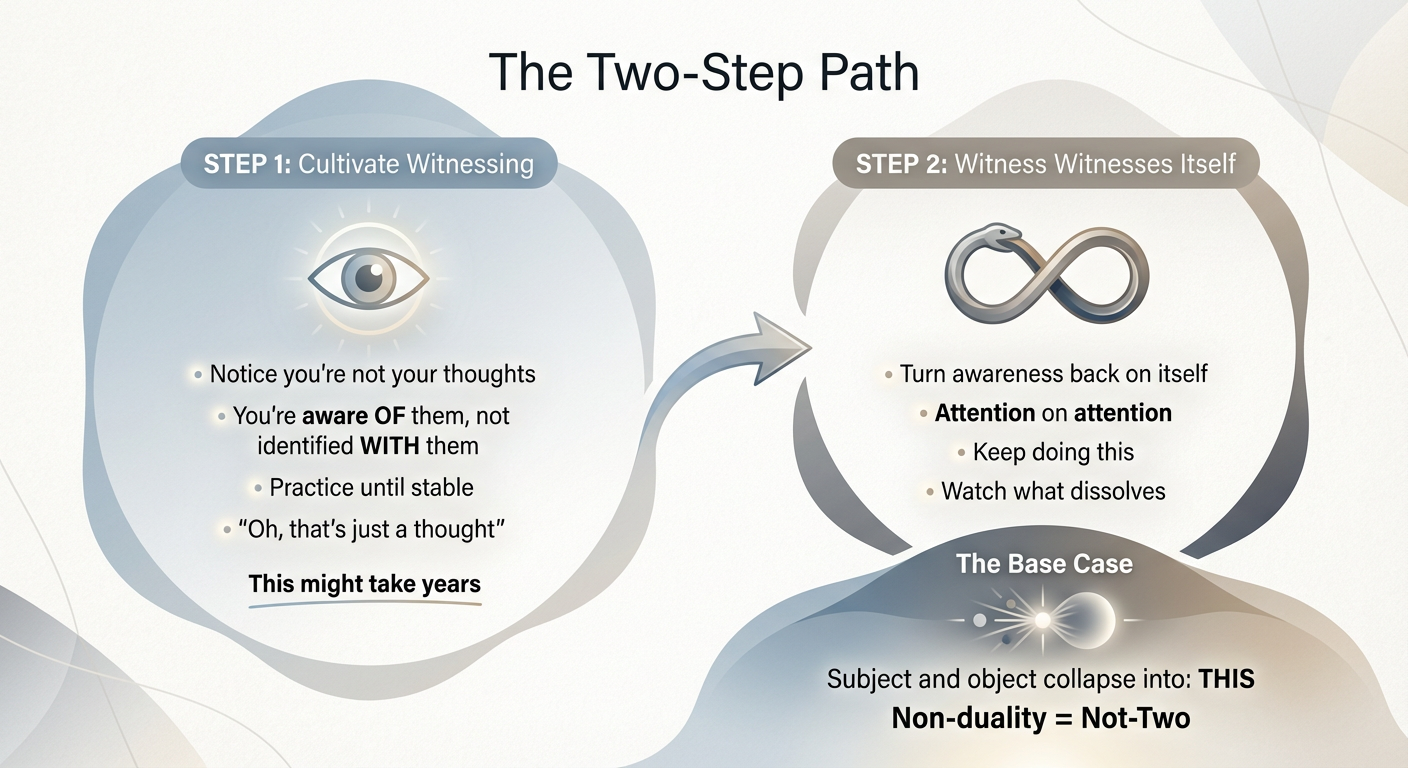
STEP 1: Witness the contents
↓
STEP 2: Witness witnesses itself
↓
Dissolution
Step 1: Cultivate witnessing
Practice noticing that you’re not your thoughts, feelings, sensations, circumstances. You’re aware of them, which means you can’t be them.
Do this until witnessing is stable. Until you can reliably recognise: “Oh, that’s just a thought. That’s just a feeling. That’s just identity doing its thing.”
This might take years. Most spiritual practice is actually just Step 1.
Step 2: Witness witnesses itself
Once witnessing is stable, turn it back on itself.
Not as technique. Not as another thing to do.
Just: place attention on awareness itself.
Keep doing this.
And watch what dissolves.
What Dissolves

When witness witnesses itself long enough, even the distinction between witness and witnessed starts to dissolve.
Because if awareness is aware of awareness… where’s the boundary?
Subject and object collapse into just… this.
Non-duality. Not-two.
That’s the base case. That’s where the recursion stops.
Not because you figured it out or forced it or let go perfectly.
But because there’s genuinely no one left to recurse.
The Warning Label
Here’s the thing though:
Step 2, if you keep going, leads to full enlightenment. Complete dissolution of self. Waking from the dream entirely.
Which is fine if that’s your function. If that’s what you’re here for.
But if you want Human Adulthood — lucid in the dream, but still playing — then you have to stop before everything dissolves.
How do you know when to stop?
Somatic intelligence.
There’s a knowing in the body that’s neither identity (which grasps and fears) nor witness (which doesn’t do anything).
It’s the thing that makes choices without being identified with them.
The thing that knows what’s needed and acts accordingly.
Some people call it intuition, or indication, or just: the body knows.
That’s what decides whether you keep going or stabilise here.
Not your mind. Not your preferences. Not your spiritual ambitions.
Just: what’s actually needed for your particular pattern.
The Pitfalls
This looks simple. Two steps. What could go wrong?
A lot, actually.
Pitfall 1: Step 1 isn’t stable yet
You read this and think “Oh, I get it — I’m the witness, not the thoughts.” You try Step 2 immediately.
But if witnessing isn’t actually stable — if you can’t reliably recognise yourself as awareness rather than content — then Step 2 just becomes another mental exercise.
You’re thinking about awareness instead of being awareness aware of itself.
And thinking about it doesn’t do anything. It’s just more content in awareness.
How to know if Step 1 is stable:
Can you notice a thought as a thought, in real-time, without getting swept into it? Can you feel an emotion fully without becoming it? Can you watch identity doing its thing — grasping, defending, performing — and recognise “that’s not me, that’s the pattern operating”?
If yes: Step 1 is probably stable enough. If no: keep practising Step 1. There’s no rush. Most people spend years here, and that’s fine.
Pitfall 2: Using Step 2 as escape
Witness-witnessing-itself can become a refuge. A place to retreat when life gets hard.
Everything too loud, too demanding, too much? Just turn attention back on witness and let it all fade into background noise.
This isn’t wrong exactly. It’s just… not the point.
The point isn’t to escape the dream. The point is to recognise you’re dreaming while still engaged with it.
How to know if you’re escaping vs practising: Does witness-witnessing-itself make you more functional or less? More present with people or more checked out? More able to take clear action or more paralysed? If it’s making you less engaged, you’re probably using it as dissociation rather than realisation.
Pitfall 3: Making it a technique
“Okay, got it. Witness witnesses itself. I’ll do that for 20 minutes every morning.”
No.
This isn’t meditation. It’s not a practice you do at specific times. It’s a recognition that becomes available more and more frequently until it’s just… how you operate. You can’t schedule dissolution. You can only keep orienting toward it and let it happen when it happens.
Pitfall 4: Trying to force dissolution
“I’ve been doing Step 2 for three weeks and nothing’s happening. I must be doing it wrong.”
You can’t make it happen faster. You can’t try harder at not-trying.
The dissolution happens when it happens. Your job is just to keep placing attention on awareness and get out of the way.
Some people: fast. Some people: slow. Some people: it comes in waves — dissolution, reconstitution, dissolution again. None of that means anything about you or whether it’s working.
Pitfall 5: Ignoring the body
This can become very heady. Very “I’m pure awareness, the body is just appearance.”
True, but also: you’re incarnate awareness. The body is how awareness interfaces with reality.
If you’re not breathing, not moving, not eating properly because you’re so focused on witness-witnessing-itself… you’re doing it wrong. The body has intelligence. Let it do its thing while awareness recognises itself.
Pitfall 6: Mistaking altered states for realisation
Sometimes when attention is fully on awareness, everything gets very quiet. Very spacious. Maybe even blissful. That’s nice. But it’s not the point. The point isn’t the state. The point is the seeing.
How to tell the difference: Can you access this seeing in any moment, regardless of conditions? Or only when you’re calm, meditative, undisturbed? If you can only access it in special circumstances, it’s probably a state, not realisation. If you can remember to look and it’s immediately there — even in the middle of chaos — that’s realisation.
Pitfall 7: Thinking you’re done
You have a profound experience. Everything dissolves. No self, just this, pure awareness.
And then you come back and think “Okay, I got it. I’m enlightened now.”
Probably not.
Probably you had an experience of no-self, but identity reconstituted after.
How do you know? Are you still bothered by things? Still grasping? Still defending? Then identity is still operating, even if you’ve seen through it temporarily.
Real stabilisation means: the seeing doesn’t go away. You might forget to look at it, but when you remember, it’s always there.
How to Practice
For Step 1:
Notice thoughts as thoughts. Not their content, but their nature.
A thought appears. Notice: “That’s a thought.” Don’t engage with whether it’s true or false, useful or useless. Just notice it’s a thought.
Same with feelings. A feeling arises. Notice: “That’s a feeling.” Don’t push it away, don’t get lost in it. Just recognise it as content in awareness.
Do this constantly. While walking, eating, talking, working. Anytime you remember.
Over time, witnessing becomes more and more natural. More stable.
When Step 1 is stable:
Start noticing the witness itself. Not what it’s witnessing. The witness.
What is aware of thoughts? That. What is aware of feelings? That. What is aware of the body, circumstances, everything? That.
Place attention there. Not as effort. Not as concentration. Just: notice what’s noticing.
Then: Keep doing that. That’s it. That’s Step 2. Attention on awareness itself, as often as you remember. And watch what happens.
What It Looks Like When It’s Working
Early signs:
Things that used to hook you don’t hook as much. Drama that used to feel overwhelming feels like… weather. It’s happening, but you’re not in it. There’s more space. Between stimulus and response, between thoughts, between everything. Decision-making gets clearer. Not because you’re thinking harder, but because you’re thinking less. Something just… knows what’s needed.
Middle stage:
Identity still operates, but you see it operating. “Oh, there’s the grasping pattern. There’s the defence mechanism. There’s the story about how I’m not enough.” You see it with affection, almost. Like watching a child play. But you’re not identified with it anymore. You can let it run its program without believing it’s you.
Advanced:
The sense of being a separate self becomes obviously absurd. Not intellectually. Viscerally. Like: you can still function, make choices, interact with people. But the feeling of being a separate entity doing those things? Gone. There’s just… this. Awareness aware of itself, expressing through a particular body-mind configuration. And that’s fine. That’s enough.
What It Looks Like When You’re Stuck
You know you’re stuck when:
You can explain the teaching perfectly but it doesn’t change anything. You understand intellectually that you’re awareness, but you still feel like identity. You’re trying to make it happen. Efforting toward effortlessness. You’re using spiritual concepts to avoid practical responsibility. “I’m just awareness, so I don’t need to deal with my problems.” You’re waiting for some future moment when it’ll finally click instead of looking right now. You’re comparing your progress to others or to some imagined timeline. You’re asking “Am I enlightened yet?” (If you have to ask, you’re not. And also: that’s the wrong question.)
What to do when you’re stuck:
Stop trying so hard. Go take care of something practical. Walk the dog. Do the dishes. Pay a bill. Let the body move without identity trying to manage everything. And when you remember — not as technique, just as recognition — notice: what’s aware right now? That’s all you ever have to do.
Why This Isn’t What You Think It Is
Look, there are ten thousand paths. Ten thousand teachers. Ten thousand techniques. Meditation. Inquiry. Devotion. Energy work. Shadow integration. Therapy. Plant medicine. Breathwork. The list goes on.
And they all work. Sort of. For some people. Sometimes.
But here’s what most of them miss:
They’re trying to improve the self instead of seeing through it.
They’re making identity better, shinier, more functional, more healed. Which is fine. Nothing wrong with that. But it’s not this. This isn’t about becoming a better version of you. This is about recognising you were never the version in the first place.
The Trap of Spiritual Practice
Here’s what usually happens:
You realise you’re suffering. You want it to stop. So you find a practice. Meditation, let’s say. You sit. You watch your thoughts. Over time, you get better at it. More calm, more centred, less reactive. This is good. This is Step 1.
But then what?
Most people stop there. They’ve found a technique that makes life more manageable, and they just… keep doing it. Twenty years of meditation. Very peaceful. Very wise-seeming. But still identified. Still believing they’re the one who meditates, the one who’s peaceful, the one who’s made progress.
The practice became another identity.
“I’m a meditator. I’m spiritual. I’m awakened.” Subtle, but it’s the same trap.
What Makes This Different
The two-step path isn’t about adding anything. It’s not about becoming more aware, more present, more anything.
It’s about recognising what’s already true and never wasn’t.
You ARE awareness. Right now. Always have been.
The whole search — every practice, every teacher, every breakthrough — is awareness looking for itself while being itself the entire time.
Step 1 (cultivate witnessing) is really just: stop being so distracted by content that you forget what’s watching it.
Step 2 (witness witnesses itself) is: stop even looking at content, look at what’s looking.
And then it becomes obvious. Not as achievement. As recognition.
“Oh. It’s been this the whole time.”
The Somatic Intelligence Question
Okay, so if identity dissolves, who makes decisions?
This is the question that freaks people out. “If there’s no me, who’s going to pay the bills? Who’s going to raise my kid? Who’s going to know what to do?”
Answer: the body-mind knows.
There’s an intelligence that operates without identity. You’ve experienced this already, probably. Times when you’re in flow and the right action just… happens. No deliberation, no second-guessing. Just: body moves, words come out, things get handled. That’s not identity. That’s the system functioning. Identity is actually what gets in the way of that. Identity second-guesses, doubts, needs to control the outcome, worries about looking bad.
When identity is out of the way — not suppressed, but genuinely seen through — the body-mind functions better. More efficient. More responsive. Less neurotic.
But here’s the paradox:
You can’t try to operate from body-mind intelligence. Trying is identity again. You just have to recognise you’re not identity, and then… the body does what it does.
The Agency Problem
“But if there’s no me making choices, how is there any agency at all? Am I just a puppet? Is everything deterministic?”
This is where language breaks down.
From identity’s perspective: someone has to be in control or everything falls apart. From awareness’s perspective: there is no one in control, things just happen, and that’s fine. From somatic intelligence perspective: choices are made, actions are taken, but there’s no separate self authoring them.
All three are true simultaneously from their own frame.
But in practice:
When you’re living this, the question doesn’t matter anymore. Things need doing? They get done. Decisions need making? They get made. But there’s no one stressed about it, no one taking credit or blame, no one worried whether they’re doing it right. It just… flows.
The Human Adulthood vs Enlightenment Thing
Quick clarification:
Human Adulthood: You see through identity, you operate from awareness, but you’re still engaged with life. Still playing in the dream, just lucidly.
Enlightenment: Even the witness dissolves. No observer, no observed. Not even awareness aware of awareness. Just… this. Undefined. Unnameable.
Most people stop at Human Adulthood. Not because they’re afraid or incomplete, but because that’s what their pattern is for. Some patterns are here to be fully in the world, translating between paradigms, helping others see what they couldn’t see. Those patterns need to stay functional at Human Adulthood level. Other patterns are here to go all the way. To dissolve completely. No better or worse. Just different functions.
How do you know which you are? The body knows. There’s a somatic sense of whether you’re supposed to keep going or stabilise here. Not identity deciding. Not ambition. Not fear. Just: what’s true for this pattern. Trust that.
When It Gets Weird
Sometimes this process breaks reality.
Not metaphorically. Literally.
Things start happening that don’t make sense from the old paradigm. Synchronicities pile up. Right people appear at right times. Resources show up exactly when needed.
Not because you’re manifesting or attracting or whatever the fuck the New Age people say.
But because when identity isn’t running the show, the system naturally aligns with… whatever it’s aligned with. Life. Reality. The pattern that wants to express through this particular form.
This can be disorienting.
Because from identity’s perspective, you’re not doing anything. You’re not making it happen. But things are happening anyway. Sometimes very precisely. Sometimes impossibly.
What to do with this:
Don’t make it mean something. Don’t turn it into a new identity: “I’m so aligned now, things just flow for me.” Just notice it. Say “huh, interesting.” Keep going. The weirdness is just… what happens when the interference pattern drops.
What This Costs
Let’s be honest about what you’re signing up for.
This path will take everything.
Every identity you’ve built. Every story about who you are and what you’re supposed to do. Every strategy you’ve used to feel safe, significant, successful. All of it gets seen through and dropped.
You will lose:
- The sense that you’re special
- The need to prove anything
- The desire for recognition
- Most of your preferences about how things should be
- The ability to take yourself seriously for very long
- A lot of relationships that were based on mutual identity-reinforcement
You will keep:
- Function (probably better than before)
- Clarity (definitely better than before)
- Capacity to be with what is (infinitely better than before)
- Sense of humour about the whole thing
- Ability to help others who are where you were
Is that trade worth it? Only you know.
But if you’re reading this and something in you is saying “yes, this, I need this” — you probably don’t have a choice. The pattern is already pulling you toward dissolution whether you like it or not. Might as well cooperate.
The Part Nobody Talks About
Here’s what teachers don’t usually mention:
Even after profound realisation, even after identity dissolves, even after you’re stable as awareness…
Life still has weather.
You still get tired. Still get sick. Still have responsibilities. Still have days where nothing works and you just want to zone out in front of the TV.
The difference is: you’re not making it mean something. Not making tiredness mean “I’m failing.” Not making difficulty mean “I’m not actually awake.” Not making anything mean anything about you, because there’s no you for it to mean something about.
It’s just… weather.
And that’s actually the freedom.
Not that everything becomes perfect. But that everything becomes okay exactly as it is. Even when it’s not okay at all.
Conclusion
So here it is. The whole thing.
Step 1: Recognise you’re awareness, not the content in awareness. Practise until this is stable.
Step 2: Turn awareness back on itself. Keep doing this until the distinction between witness and witnessed dissolves.
That’s it.
Not sexy. Not complicated. But absolutely ruthless.
Because if you actually do this, everything you think you are will dissolve. And you can’t take that back. You can’t unknow what you see when you look directly at awareness. You can’t rebuild identity the same way after you’ve seen through it completely.
So before you start:
Ask yourself: do you actually want this? Not “do you want to be free of suffering” (everyone wants that). Not “do you want to be enlightened” (that’s probably just spiritual ambition). But: do you want to know what’s true, even if it costs you everything?
If the answer is yes — genuinely yes, from somewhere deeper than preference — then this path will work.
Because it’s not really a path. It’s just… looking at what’s already here until you can’t look away.
And once you see it, you can’t unsee it.
You can forget to look at it, sure. Get distracted by life, by problems, by all the content. But the moment you remember to look: there it is. Obvious. Undeniable. Always been there.
You. As awareness. Watching everything. Being everything.
Not as concept. As direct recognition.
And then what?
Then you live. Make breakfast. Walk the dog. Handle whatever needs handling. But lightly. Without the weight of identity making it all so fucking serious.
Just: this happening, for no reason, as no one in particular.
And somehow that’s enough.
Somehow that’s everything.
Q&A
Q: How long does this take?
A: Depends entirely on how stable Step 1 is. Some people have been practising witnessing for decades and Step 2 happens fast. Some people are brand new and it takes years to stabilise Step 1. There’s no timeline. Stop asking.
Q: Can I do this while working a normal job, raising kids, living a regular life?
A: Yes. This isn’t about retreating from life. It’s about seeing clearly while fully engaged. You don’t need special circumstances. You need attention.
Q: What if I get scared during the dissolution?
A: You probably will. Identity doesn’t want to die. It’ll create fear, doubt, confusion — anything to make you stop looking. When that happens: notice that too. Notice the fear. Notice who’s noticing the fear. Keep going.
Q: How do I know if I’m doing it right?
A: You don’t. Stop trying to know. Just keep placing attention on awareness and let whatever happens happen.
Q: Is this the same as [insert other teaching here]?
A: Probably points at the same thing from different angles. Don’t get caught up in comparing. Just do the practice and see what happens.
Q: What if nothing happens? What if I’m just sitting here watching awareness and nothing dissolves?
A: Keep going. You’re probably still trying to make something happen. Stop trying. Just look. When you’re genuinely not trying to get anywhere, dissolution happens by itself.
Q: Can you get stuck in Step 2? Like, too dissolved to function?
A: Temporarily, maybe. If that happens, engage with something practical. Move your body. Do something that requires attention to detail. The system will recalibrate. But if you’re genuinely concerned you’ve dissolved too much to function, you probably haven’t actually dissolved — you’re probably just dissociating.
Q: What about relationships? Can you be intimate with someone if there’s no self?
A: Yes. Actually, more intimate. Because you’re not defending, performing, or needing anything from the other person. You can just… be with them. Fully present, no agenda.
Q: Does this mean my problems will magically solve themselves?
A: No. You’ll still have problems. You’ll just stop making them mean something about you. And weirdly, when you stop grasping at solutions, solutions often show up on their own. But don’t do this to fix your problems. Do it to see what’s true.
Q: What if I realise I’m awareness but life still sucks?
A: Then you’ve had a realisation but haven’t stabilised it. Keep practising. The suffering means identity is still operating, even if you’ve seen through it intellectually.
Q: Is this dangerous?
A: Depends what you mean by dangerous. Will it kill your identity? Yes, that’s the point. Will it make you dysfunctional? Temporarily, maybe. Long-term? No. You’ll probably function better. But if you have serious mental health issues, get support. This isn’t therapy. This isn’t a fix for trauma or chemical imbalance. This is for people who are functional enough but fundamentally unsatisfied with the whole identity project.
Q: Do I need a teacher?
A: Helpful but not required. A teacher who’s been through it can point at what you’re missing, can confirm when you’re on track, can laugh at you when you’re being precious about it. But ultimately you have to see it yourself. No one can do it for you.
Q: What’s the difference between this and just being checked out / dissociated?
A: Dissociation is avoidance. You’re numbing out to avoid feeling something. This is the opposite — you’re more present, more feeling, more engaged. Just not identified. If you’re less functional, less able to be with people, less responsive to what’s happening — that’s dissociation, not realisation.
Q: Can I lose this once I have it?
A: You can forget to look at it. But once you’ve seen it, you can’t unsee it. The recognition is permanent, even if your attention wanders from it.
Q: What do I do if my family thinks I’ve gone crazy?
A: Stop talking about it. Seriously. You don’t need to explain your realisation to anyone. Just live it. If they notice you’re different, lighter, less neurotic — great. But don’t make it a thing. The need to have your realisation validated is just identity again.